


 PLATFORM UPDATE:

Pollution characteristics and ecological risks of perfluoroalkyl substances at key discharge points in the Wei River Basin
 *ac
*ac
Abstract
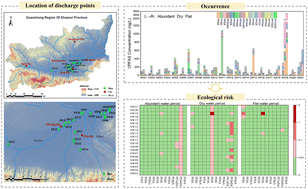
Per- and polyfluoroalkyl substances (PFAS) are increasingly recognized as persistent global contaminants with significant health implications. This study offers the first thorough assessment of 19 PFAS across 21 discharge points in Xi'an and Xianyang within the Wei River Basin, utilizing an advanced online solid-phase extraction with liquid chromatography–tandem mass spectrometry (SPE-LC-MS/MS). Notably, we observed distinct seasonal variations in ∑PFAS concentrations: dry water period (January 2024: 141.3–1930.7 ng L−1, averaging 360.7 ng L−1) > flat water period (May 2024: 7.9–2704.6 ng L−1, averaging 245.4 ng L−1) > abundant water period (September 2023: 22.0–637.4 ng L−1, averaging 145.4 ng L−1). Short-chain PFAS, especially perfluorobutanoic acid (PFBA) and perfluorobutanesulfonic acid (PFBS), were predominant, with over 90% detection frequencies in all water periods. Only one critical finding was the elevated PFOS level at the SW19 discharge point, reaching 1427.0 ng L−1 during the flat water period—28 times higher than the US EPA's advisory limit for drinking water. Ecological risk assessments indicated SW19 exhibits high risks (RQ > 1) for PFOS during both flat and dry water periods, although the majority of PFAS discharge points are categorized as low or negligible risk. These results emphasize the urgent need for targeted source control in petrochemical and electronics industries, enhanced wastewater treatment technologies for short-chain PFAS, and long-term monitoring programs that account for hydrological changes. This study provides a methodological framework for monitoring multiple PFAS in complex watersheds and supports China's “New Pollutants Governance Action Plan”.
 Please wait while we load your content...


