


 PLATFORM UPDATE:


Privacy-preserving water quality forecasting using federated learning across distributed water monitoring nodes and optimized RPART modelling
 *a
and
*a
and
Abstract
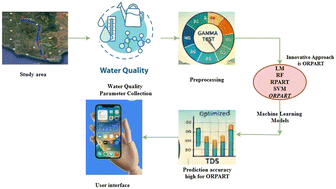
Water quality prediction is a highly important task for the anticipation and management of a polluted environment. Accurate prediction can assist in making better decisions in the area of environmental water quality. The WQI (water quality index) is the best method of measuring water quality. However, previous research has suffered from limitations, such as ambiguity and eclipsing. Machine learning algorithms are considered effective methods to rectify the limitations of conventional WQIs. The proposed model aims to detect the main water quality parameters, which include biochemical and physical features. It is also used to determine the usability of water for irrigation purposes. The proposed model uses federated learning to train optimized RPART (recursive partitioning) on water quality data such as pH, turbidity, dissolved oxygen and temperature. These data are distributed across different geographical or organizational locations without transferring raw data to a central server. The proposed algorithm demonstrates a shorter search time compared to RPART, achieving O(1) in the best case and O(log N·2d) in the worst case for completing the search operation. The dataset partitioning of 15% for testing, 70% for training, and 15% for validation indicates the robust classification and prediction performance of the WQI model for Indian reservoirs. ORPART gives 92% data accuracy, requires less search time for keys, and has high data capability with a lower error rate. The integration of the federated learning and optimized RPART techniques can lead to more efficient, sustainable, and data-driven management of irrigation water quality, benefiting agriculture, the environment, and local communities.
 Please wait while we load your content...


