


 PLATFORM UPDATE:


PtCu hydrogel self-supported metal–organic framework for sensitive electrochemical detection of o-sec-butylphenol
 *a
*a
Abstract
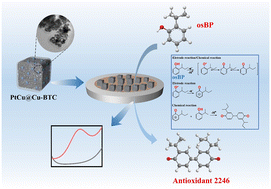
Poor conductivity and insufficient structural stability of metal–organic frameworks (MOFs) restrict their use in detecting water pollutants. In this work, a PtCu hydrogel was synthesized to support the Cu-BTC MOF (PtCu@Cu-BTC) by coordinating 1,3,5-benzenetricarboxylic acid (BTC) directly on the surface of the PtCu hydrogel for the sensitive detection of o-sec-butylphenol (osBP). Importantly, the three-dimensional network structure of the PtCu hydrogel serves as a stable scaffold, providing a matrix to load metal ions that chelate with BTC. This approach not only enhances the structural stability of the MOFs but also greatly improves their electrical conductivity, allowing the catalyst to maintain consistent catalytic activity and stability during water pollutant detection. Additionally, the in situ formed Cu-BTC coordination layer increases the specific surface area, creating numerous active sites, and offers functional groups that promote pollutant adsorption, thereby significantly boosting sensor performance. The findings show that the developed biosensor has a strong linear response to osBP concentrations ranging from 3 to 100 μM, with a low detection limit of 0.68 μM. This work offers new insights for designing MOF-based functional materials that combine excellent conductivity with robust structural stability.
 Please wait while we load your content...


