


 PLATFORM UPDATE:


Phytogenic rGO@ZnCo2O4 spinel nanoarchitecture for solar-induced detoxification of endocrine disruptors: interface engineering and charge carrier modulation
 *b
*b
Abstract
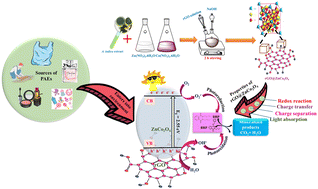
Phthalate esters (PAEs), such as dibutyl phthalate (DBP) and benzyl butyl phthalate (BBP), are ubiquitous plasticizers that persist in aquatic environments, posing severe endocrine-disrupting and carcinogenic risks. This work reports a sustainable approach for solar-driven detoxification of PAEs using a phytogenically synthesized rGO@ZnCo2O4 nanocomposite. The composite, fabricated via a green co-precipitation method employing Azadirachta indica leaf extract, integrates reduced graphene oxide with a ZnCo2O4 spinel framework to enhance light absorption, surface reactivity, and charge carrier mobility. Structural, surface and optical analyses confirmed the formation of a crystalline spinel phase with rGO incorporation, yielding a high surface area and a narrowed band gap. Electrochemical studies revealed low charge transfer resistance, while radical quenching experiments identified ˙OH and O2˙– as the primary oxidative species. Under natural sunlight, the optimized system achieved 97% DBP and 96% BBP degradation within 180 min in model solutions and over 75% removal in industrial wastewater, with substantial mineralization confirmed by TOC analysis. LC-MS and GC-MS investigations elucidated the degradation pathways, indicating transformation into low-toxicity intermediates. The catalyst exhibited excellent stability and reusability over nine cycles without structural degradation. These results establish rGO@ZnCo2O4 as a next-generation, solar-active photocatalyst that unites green synthesis, exceptional stability, and real-water applicability, paving the way for sustainable, large-scale remediation of endocrine-disrupting pollutants.
 Please wait while we load your content...


