


 PLATFORM UPDATE:


Unrefined aluminosilicate-based coagulants and sorbents for effective removal of phosphorus from wastewater: employment of natural halloysite nanostructures in the intensification of a multi-mechanism process
 a
Krzysztof
Piotrowski,
*b
Józef
Ober,
c
Klaudiusz
Gołombek,
e
Charli
Sitinjak,
f
Małgorzata
Kopiec
g
and
Krzysztof
Kiraga
b
a
Krzysztof
Piotrowski,
*b
Józef
Ober,
c
Klaudiusz
Gołombek,
e
Charli
Sitinjak,
f
Małgorzata
Kopiec
g
and
Krzysztof
Kiraga
b
Abstract
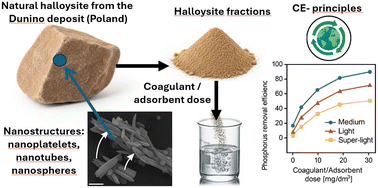
The results of laboratory tests and preliminary industrial research related to the original use of coagulants produced from aluminosilicate clay—activated halloysite—based on an exemplary unrefined geological mineral with natural nanostructural elements—nanotubes, nanoplatelets, and nanospheres—for multi-mechanistic integrated sorption and coagulation-based capture of phosphorus from multi-component sewages are presented. According to the circular economy (CE) approach, the use of simple methods of physical pretreatment of halloysite, without chemical functionalization or purification, was a conscious research strategy, justified by technological, economic and environmental aspects. A product manufactured on the basis of unrefined natural nanostructural aluminosilicates—halloysite mineral—after dedicated functionalization can simultaneously act as a sorbent, a coagulant and a weight for the emerging aggregates—flocs—accelerating their sedimentation. The presented original technological concept of a simplified, cleaner production process for an adsorbent and coagulant based on halloysite was positively verified for real sewages. Research based on the selected exemplary geological deposit of Dunino in Poland, where the mineral contains mainly natural nanostructural halloysite, along with kaolinite, hematite, magnetite, quartz, magnesioferrite, rutile, ilmenite, geikielite, goyazite, and crandallite, showed that the minerals naturally co-present in the raw material have a positive effect on the more effective separation of phosphorus from sewages. Their co-presence, as well as element substitutions, in the spatial nanostructural forms of halloysite and on its surface has proven to be technologically beneficial due to synergistic physical and chemical interactions, providing in effect more effective sorption and coagulation processes. The aim of this study was to evaluate the effectiveness of phosphate removal from real municipal wastewater using natural, chemically untreated halloysite and to identify the process dependencies between its fractional composition and the resulting coagulation and sorption efficiency in the separation of phosphorus compounds from solutions of different compositions.
 Please wait while we load your content...


