


 PLATFORM UPDATE:

Land application of biosolid, livestock, and drilling wastes to US farmland: a potential pathway for the redistribution of contaminants in the environment
 *a
Dana W.
Kolpin,
b
Isabelle M.
Cozzarelli,
c
Denise M.
Akob,
c
Christopher H.
Conaway,
d
Carrie E.
Givens,
e
Michelle L.
Hladik,
f
Laura E.
Hubbard,
g
Rachael F.
Lane,
h
R. B.
McCleskey,
i
Todd M.
Preston,
j
Clayton D.
Raines,
k
Matthew S.
Varonka
c
and
Michaelah C.
Wilson
h
*a
Dana W.
Kolpin,
b
Isabelle M.
Cozzarelli,
c
Denise M.
Akob,
c
Christopher H.
Conaway,
d
Carrie E.
Givens,
e
Michelle L.
Hladik,
f
Laura E.
Hubbard,
g
Rachael F.
Lane,
h
R. B.
McCleskey,
i
Todd M.
Preston,
j
Clayton D.
Raines,
k
Matthew S.
Varonka
c
and
Michaelah C.
Wilson
h
Abstract
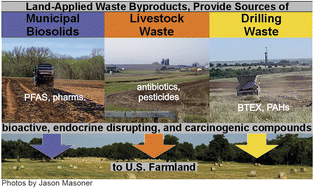
In the United States (U.S.), waste byproducts generated from the treatment of municipal waste (biosolids), production of livestock (livestock waste), and drilling of oil and gas wells (drilling waste) are commonly applied to agricultural lands. Although this can be a cost-effective reuse/disposal practice, there is limited research on the potential for contaminant exposures and effects on ecosystems, wildlife, and human health from such land applications. In this study, we conducted extensive chemical, microbial, and toxicity analyses of biosolid, livestock, and drilling wastes just prior to land application on agricultural lands at 34 sites across the U.S. Twenty-two analytical methods were used to determine potential contaminant exposures profiles for 452 organic and 114 inorganic chemicals, nine microbial groups, estrogenicity, and cytotoxicity. Analytical results document unique and substantial chemical, microbial, and toxicity profiles for these land-applied wastes. Of the three waste byproducts, biosolids contained the greatest concentrations of household chemicals, pesticides, pharmaceuticals, per-/polyfluoroalkyl substances, calcium, and phosphorus. Livestock waste contained the greatest concentrations of total and leachable dissolved organic carbon, biogenic hormones, mycotoxins, plant estrogens, total inorganic nitrogen, and potassium. Drilling waste contained the greatest concentrations of BTEX compounds (benzene, toluene, ethylbenzene, and xylenes), polycyclic aromatic hydrocarbons, rare-earth elements, barium, strontium, and uranium–thorium series radioisotopes. Biosolid and livestock wastes had greater culturable heterotrophic bacteria, halophilic bacteria, Escherichia coli (E. coli), enterococci, and staphylococci concentrations, and greater microbial diversity than drilling waste. Bioassay analyses indicated that exposure to contaminants in livestock wastes and biosolids could result in estrogenic effects, whereas exposure to contaminants in drilling waste could result in cytotoxic effects. Our study documents that current reuse/disposal practices for biosolid, livestock, and drilling wastes on agricultural lands could provide a potential pathway for the redistribution of unique and complex contaminant mixtures into the environment that have bioactive, endocrine disrupting, and carcinogenic characteristics. Results of this study provide a snapshot of chemical compositions and concentrations that can be used to inform the development of best-management practices to help maximize beneficial reuse of these wastes and minimize risk to the environment and human health.
 Please wait while we load your content...


