


 PLATFORM UPDATE:

Modified MAGIC model to assess and predict acidification effects on water chemistry changes in Taihu lake, China
 a
a
Abstract
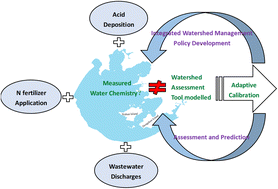
Acid deposition, nitrogen (N) fertilizer and wastewater discharge are multiple stressors producing great impacts on natural water chemistry. However, few studies have quantitatively estimated the effects of these stressors on Taihu water chemistry. Here, the MAGIC model was used to simulate and predict long-term changes in lake water chemistry after adaptive modifications. Long term historical water chemistry data and our field data on soil properties were used to calibrate the model. The result indicated that Cl−, Na+, and SO42− were the most sensitive to wastewater discharges, resulting in around an 80% increase in Cl− and Na+; and after “wastewater calibration” the modelled results were in good agreement with calculated ones. Modelled Ca2+ and Mg2+ losses were consistent with measured results before 2000, and the acid deposition-induced effect was not different from the combined effect of acid deposition and N fertilization application; while after that base cation losses caused by dual acidification were significantly higher than those caused by acid deposition alone, which corresponded well with the N fertilizer consumption and SO2 emissions. The modelled results indicated that after 2000, the annual loss of Ca2+ and Mg2+ caused by double acidification (acid deposition and N fertilization) was 27% and 11% higher than that caused by acid deposition, respectively. The MAGIC prediction based on different scenarios showed that the reduction of wastewater discharge would effectively inhibit the increase of Cl−, Na+, and SO42−, while the effect of acidification would last longer than expected even under SO2 reduction. This work is expected to provide a scientific basis for integrated watershed management and recovery planning.
 Please wait while we load your content...


