


 PLATFORM UPDATE:


Self-adaptive interfacial cooling for sustainable energy–water cogeneration in photovoltaics
 a
a
Abstract
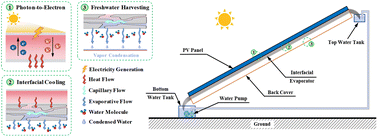
The simultaneous production of electricity and freshwater via solar energy offers a promising approach to addressing global energy and water challenges. Here, we present a self-adaptive interfacial evaporation-driven photovoltaic energy–water cogeneration (IEWC) system that passively integrates thermal regulation with atmospheric water harvesting to enhance photovoltaic (PV) performance. By coupling a commercial PV module with a hydrophilic thin-film evaporator, the system enables efficient heat extraction and adaptive evaporative cooling, reducing surface temperature and suppressing thermal losses. Outdoor testing demonstrated a power output increase of 8.4% and a temperature reduction of up to 23 °C compared to standalone PV modules. Life-cycle techno-economic analysis shows that IEWC consistently yields the lowest relative operational level (ROL) among various PV cooling strategies across discount rate scenarios. Under a 5% technological improvement assumption, projected annual savings reach USD 17.48 billion (1.6‱ of global GDP), alongside notable reductions in CO2 emissions, land use, and freshwater demand. The system performs reliably under variable outdoor conditions, making it suitable for off-grid and arid deployments. These findings highlight IEWC as a scalable, energy-autonomous solution for integrated power and water generation, with strong potential to advance sustainable and resilient solar infrastructure.
 Please wait while we load your content...


