


 PLATFORM UPDATE:


Electron-withdrawing groups as property tuners in functionalized terpyridine-based ligands in Eu(iii) and Tb(iii) complexes

Abstract
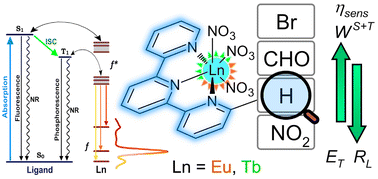
Three terpyridine derivatives with electron-withdrawing groups in the ortho-position of terpyridine, –NO2 (terpyNO2), –CHO (terpyCHO) and –Br (terpyBr), were isolated and the influence of these substituents on the chemical and photophysical characteristics of the corresponding Eu(III), Tb(III) and Dy(III) complexes was assessed and compared with the complexes with unsubstituted terpyridine. A direct correlation between the complex stability constants and the second pKa2 values of the free ligands was found. Emission quantum yields indicate moderate ability to sensitize the metal-centered emission. Judd–Ofelt intensity parameters and energy transfer rates were calculated for all complexes. A direct correlation was found between the forward energy transfer rates and the sensitization efficiency for the Eu(III) complexes. For the Tb(III)-based complexes back-energy transfer from the metal ion to the ligands’ triplet level dominates. At 298 K, the Eu(III) complexes displayed emission lifetimes in the range 1.49–1.68 ms, while for the Tb(III) complexes the lifetimes were in the range 0.71–1.17 ms. The lifetimes of all the complexes could be fit with a single exponential at this temperature. However, at 77 K, double-exponential decay was observed. Nuclear magnetic resonance (NMR) analysis and density functional theory (DFT) calculations, modeled on the Eu(III)-terpyNO2 complex are consistent with decomplexation and subsequent rotation of one of the ligand's pyridine rings, which lead to the observed two species in frozen solution.
- This article is part of the themed collection: Dalton Transactions HOT Articles
 Please wait while we load your content...


