


 PLATFORM UPDATE:


Pyridyl β-ketoenols, pyrazoles and their zinc complexes: synthesis, photophysical properties, and DNA binding

Abstract
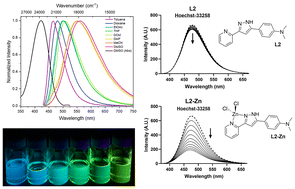
A new series of pyridyl β-ketoenols, pyrazoles, and their zinc(II) complexes was synthesized and characterized to investigate photophysical behavior, DNA binding capabilities, and structure–function relationships. β-Ketoenols L1 and L3, prepared by mixed Claisen condensation, were cyclized with hydrazine monohydrate to form pyrazoles L2 and L4. Zinc complexes (L2-Zn and L4-Zn) were obtained by direct coordination of ZnCl2 to the pyrazoles. Single-crystal X-ray diffraction revealed flat and highly conjugated structures for L1 and L2, with tautomeric flexibility in L3 as both bis-β-ketoenol and β-ketoenol–β-diketone desmotropes were isolated. L4 displayed a break in planarity through intermolecular hydrogen bonding, while L4-Zn exhibited a distorted five-coordinate geometry. All ligands and complexes showed strong fluorescence with large Stokes shifts and solvatochromic behaviour in L1–L4, coincident with significant ground-to-excited-state dipole changes. DNA binding was evaluated via induced circular dichroism (ICD) and competitive dye displacement assays. Uncyclized ligands L1 and L3 displayed no detectable DNA interaction. Cyclized L4 produced a strong positive ICD signal, consistent with minor groove binding, while L2 showed negligible binding. Zinc complexation enhanced DNA affinity with both L2-Zn and L4-Zn, displacing Hoechst-33258, confirming selective minor groove binding.
 Please wait while we load your content...


