


 PLATFORM UPDATE:


Design of titanium-oxide cluster-based metal-covalent organic frameworks for efficient photocatalytic CO2 reduction

Abstract
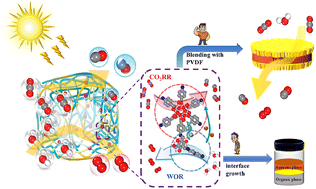
In response to the growing global energy requirements and escalating environmental issues, photocatalytic reduction of CO2 has gained significant attention as an effective strategy for carbon resource reutilization and addressing climate change. In this study, a series of metal-covalent organic frameworks (MCOFs) incorporating titanium-oxide clusters (Ti6) were systematically designed and synthesized. By tuning the Ti6 incorporation ratio, MCOF-TDT was found to exhibit an outstanding CO generation rate with the highest formation rate of 168 μmol g−1 h−1. To further enhance the practical applicability of the photocatalyst, a MCOF layer was grown on a pre-synthesized Ti6/PVDF substrate, successfully yielding MCOF-TDT/PVDF composite membranes, which achieved a CO generation rate of 78 μmol g−1 h−1. The incorporation of the PVDF substrate significantly improved the mechanical stability of the membrane while preserving much of its photocatalytic activity. This study presents a novel strategy for designing high-performance, stable photocatalytic materials and broadens the application scope of titanium-oxide cluster-based MCOFs in photocatalysis.
 Please wait while we load your content...


