


 PLATFORM UPDATE:


Crystal structure and physical properties of Na2Mn3(Si3O10) – a new representative of the series of trisilicates A2M3(Si3O10)
 *a
Galina
Kiriukhina,
ab
Anatoly
Volkov,
c
Olga
Dimitrova,
a
Larisa
Shvanskaya
ad
and
Alexander
Vasiliev
ad
*a
Galina
Kiriukhina,
ab
Anatoly
Volkov,
c
Olga
Dimitrova,
a
Larisa
Shvanskaya
ad
and
Alexander
Vasiliev
ad
Abstract
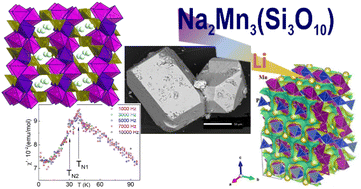
Single crystals of a manganese-containing member in the series of trisilicates A2M3(Si3O10), where A = Na and K, and M = Ca, Cd, and Mn, were obtained by mild temperature hydrothermal synthesis at 280 °C and 50 atm. Na2Mn3(Si3O10) crystallizes in the monoclinic space group C2/c, with a = 16.1195(9), b = 5.0089(3), c = 10.7158(6), β = 94.078(6), and Z = 4. Its crystal structure is built from trimers of edge-sharing Mn-centered polyhedra forming MnO5–MnO6–MnO5 linear clusters arranged in a staggered pattern and linked together via oxygen vertices in the layers. The layers are further connected by (Si3O10) groups of tetrahedra in a framework with Na atoms in its channels. The trisilicate assemblages of tetrahedra are close to a linear configuration with an Si2–Si1–Si2 angle of 154.1°. No mobility of Na+ ions through the structural channels was observed. The migration of Li+ ions was estimated by assuming a possible Li-analog, Li2Mn3(Si3O10). As a result, biperiodic pathways organized by a network of voids that bends around the trisilicate groups and lies between the layers of Mn-centered polyhedra were found for Li atoms. The conductivity of Li+-ions was confirmed by bond valence energy landscape (BVEL) calculations, which showed energy barriers of 0.4 eV and 0.7 eV along the b and c axes (2.6 eV along the a axis). The theoretical specific capacity for Li2Mn3(Si3O10) is 126.74 mAh g−1 for both Li atoms per formula unit. The ground state of Na2Mn3Si3O10 is a canted antiferromagnet reached through a sequence of two phase transitions at TN1 = 29 K and TN2 = 39 K.
 Please wait while we load your content...


