


 PLATFORM UPDATE:


The electrochemistry of neptunium in tri-n-butyl phosphate
 a
and
Mark P.
Jensen
*ab
a
and
Mark P.
Jensen
*ab
Abstract
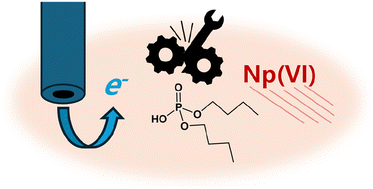
Neptunium's electrochemical behavior was studied in solutions of undiluted, acid-equilibrated tri-n-butyl phosphate (TBP) as well as in TBP solutions diluted by dodecane. Careful experimental choices and electromagnetic noise suppression allowed voltammetry in the low-conductivity 30 vol% TBP/n-dodecane solvent, bypassing the approximation of using undiluted TBP for this widely used solvent composition. In undiluted TBP, the Np(VI/V) couple is quasireversible and has a half-wave potential of 0.722 ± 0.012 V vs. Ag/AgCl. Diffusion coefficients for the Np(VI) and Np(V) species were found to be (4.3 ± 0.8) × 10−7 cm2 s−1 and (3.5 ± 0.6) × 10−7 cm2 s−1, respectively. The Np(IV/III) couple is irreversible in TBP indicating that Np(III) is unstable; however, like the Np(VI/V) couple, it shows stabilization of the more-oxidized state by TBP complexation. Spectrophotometry showed that Np(V) is unstable in undiluted TBP–HNO3, oxidizing to Np(VI) over time. Switching macroelectrodes for ultramicroelectrodes enables measurement of neptunium redox couples in TBP diluted with dodecane, and increased dilution shifts the Np(VI/V) couple to more negative potentials. Voltammetry in even 30 vol% TBP was possible with a minor amount of supporting electrolyte. The presence of di-n-butyl phosphoric acid (HDBP), a common TBP radiolysis product, stabilizes Np(VI) relative to Np(V), with exchange of one HDBP upon reduction of Np(VI).
- This article is part of the themed collection: Dalton Transactions HOT Articles
 Please wait while we load your content...


