Issue 42, 2025

NiFeCe nanosheet arrays by N and P doping as efficient electrocatalysts for the oxygen evolution reaction

Abstract

The oxygen evolution reaction (OER) is commonly considered to be the major bottleneck in electrochemical water splitting. It is characterized by high overpotential requirements and so the fabrication of low-cost and high-performing OER catalysts is of great significance for the process of electrocatalytic water splitting. Here, the nanocomposite material (denoted as N–Ni0.75Fe0.15Ce0.10P/NF) was obtained by simultaneously nitriding and phosphating the nanoneedle-like array (denoted as Ni0.75Fe0.15Ce0.10Ox/NF) grown on a nickel foam (NF). N–Ni0.75Fe0.15Ce0.10P/NF has an overpotential of only 244 mV at a current density of 50 mA cm−2, and the Tafel slope is remarkably low at 73.8 mV dec−1. The material can work stably at a current density of 50 mA cm−2 for at least 48 h, indicating good stability. This investigation introduces innovative design methodologies for OER catalysts, offering significant contributions to sustainable energy research.
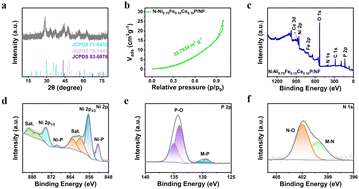
Graphical abstract: NiFeCe nanosheet arrays by N and P doping as efficient electrocatalysts for the oxygen evolution reaction

Supplementary files

Transparent peer review

To support increased transparency, we offer authors the option to publish the peer review history alongside their article.

View this article’s peer review history

Article information

Article type
Paper
Submitted
28 Jul 2025
Accepted
28 Sep 2025
First published
29 Sep 2025

Dalton Trans., 2025,54, 15917-15922

NiFeCe nanosheet arrays by N and P doping as efficient electrocatalysts for the oxygen evolution reaction

C. Xu, Q. Wang, X. Kuang, X. Sun, X. Ren, D. Wu and Q. Wei, Dalton Trans., 2025, 54, 15917 DOI: 10.1039/D5DT01787D

To request permission to reproduce material from this article, please go to the Copyright Clearance Center request page.

If you are an author contributing to an RSC publication, you do not need to request permission provided correct acknowledgement is given.

If you are the author of this article, you do not need to request permission to reproduce figures and diagrams provided correct acknowledgement is given. If you want to reproduce the whole article in a third-party publication (excluding your thesis/dissertation for which permission is not required) please go to the Copyright Clearance Center request page.

Read more about how to correctly acknowledge RSC content.

Social activity

Spotlight

Advertisements