


 PLATFORM UPDATE:

Indications of ferroelectric behaviour near room temperature in the organic–inorganic hybrid Q2CuBr4
Agnieszka
Ciżman,  *a
Dorota A.
Kowalska,
b
Paweł
Szarek,
c
Wojciech
Medycki,
d
Natalia A.
Wójcik,
e
Marek
Gusowski,
a
Monika
Trzebiatowska,
b
Adam
Bartosiewicz,
a
Liudmyla
Filevska,
a
Piotr
Staniorowski
f
and
Ewelina
Jach
*a
*a
Dorota A.
Kowalska,
b
Paweł
Szarek,
c
Wojciech
Medycki,
d
Natalia A.
Wójcik,
e
Marek
Gusowski,
a
Monika
Trzebiatowska,
b
Adam
Bartosiewicz,
a
Liudmyla
Filevska,
a
Piotr
Staniorowski
f
and
Ewelina
Jach
*a
*a
Dorota A.
Kowalska,
b
Paweł
Szarek,
c
Wojciech
Medycki,
d
Natalia A.
Wójcik,
e
Marek
Gusowski,
a
Monika
Trzebiatowska,
b
Adam
Bartosiewicz,
a
Liudmyla
Filevska,
a
Piotr
Staniorowski
f
and
Ewelina
Jach
*a
Abstract
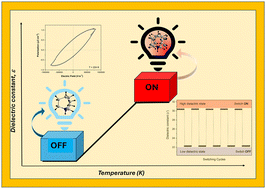
A quinuclidinium-based copper bromide molecular ferroelectric, exhibiting a polarization of Ps = 0.52 μC cm−2 at zero electric field, has been successfully synthesized. This compound undergoes an order–disorder phase transition at Tc = 295 K, associated with thermally induced rotational motion of the quinuclidinium cations. This transition results in pronounced changes in both the dielectric constant and thermal properties. The contributions of the organic and inorganic components, as well as their interactions, to the observed electrical and thermal behaviors are discussed using both experimental data and theoretical analysis.
 Please wait while we load your content...


