


 PLATFORM UPDATE:


Borane-functionalized heteroscorpionate copper complexes as catalysts for azide–alkyne cycloaddition
 *ab
Belén
López-Sánchez,
ac
M. Amélia N. D. A.
Lemos,
d
Antonio
Romerosa
c
and
Luísa M. D. R. S.
Martins
*a
*ab
Belén
López-Sánchez,
ac
M. Amélia N. D. A.
Lemos,
d
Antonio
Romerosa
c
and
Luísa M. D. R. S.
Martins
*a
Abstract
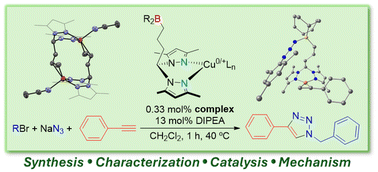
In this work, new copper(I) complexes of borane-functionalized bis(3,5-dimethylpyrazolyl)methane ligands were synthesized, characterized and used as catalysts for the cycloaddition of phenylacetylene and azides. Reaction of the allylated bis(3,5-dimethylpyrazolyl)methane proligand (La) with CuCl or [Cu(NCMe)4]BF4 gave rise to the neutral copper chloride complex [(La)CuCl] (1a) or the binuclear cationic copper complex [(La)Cu(NCMe)]2(BF4)2 (2a2), respectively. The same reactions using a borane-functionalized bis(3,5-dimethylpyrazolyl)methane proligand (Lb) led to the isolation of complexes [(Lb)CuCl] (1b) and [(Lb)Cu(NCMe)2]BF4 (2b). The new complexes were characterized by NMR and FTIR spectroscopies, elemental analysis, cyclic voltammetry and, in selected cases, single-crystal X-ray diffraction. Complexes 1a, 1b, 2a2 and 2b catalyzed the cycloaddition of phenylacetylene and in situ prepared benzyl azide to afford the respective 1,2,3-triazole products. When using complex 0.33 mol% of complex 2b in the presence of 40 equivalents of diisopropylethylamine (DIPEA), a maximum yield of 97% with a maximum TOF value of 800 h−1 was obtained. Complex 2b also catalyzed the cycloaddition of phenylacetylene with 7 azides prepared in situ in 87%–99% yields. The borane-functionalized complexes 1b and 2b were, on average, 4-fold more active than their respective allylated analogues, and complex 2b readily led to the formation of the η2-phenylacetylene complex [(Lb)Cu(η2-PhC![[triple bond, length as m-dash]](https://www.rsc.org/images/entities/char_e002.gif) CH)]BF4 (4) and the presumed detection of borane-centered Lewis pairs with MesN3. These experimental observations, along with computational insights based on DFT calculations, indicated that the respective borane functionalities are beneficial to catalytic activity due to a substrate-directing effect.
CH)]BF4 (4) and the presumed detection of borane-centered Lewis pairs with MesN3. These experimental observations, along with computational insights based on DFT calculations, indicated that the respective borane functionalities are beneficial to catalytic activity due to a substrate-directing effect.
- This article is part of the themed collection: Celebrating International Women’s Day 2026: Women in Inorganic Chemistry
 Please wait while we load your content...


