


 PLATFORM UPDATE:

Data-driven prediction of HSQ polymer structure and silicon nanocrystal photoluminescence

Abstract
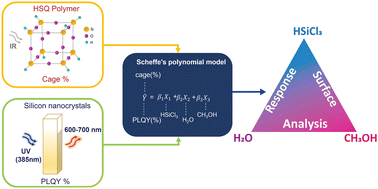
The synthesis of silicon nanocrystals through high-temperature pyrolysis of hydrogen silsesquioxane has emerged as a valuable approach for obtaining quantum-sized crystallites with controllable sizes and distinct photoluminescent maxima. Nevertheless, the use of commercial hydrogen silsesquioxane has notable disadvantages, such as poor shelf life, high cost, and limited supply, that motivate the exploration of alternative precursors. Recent studies have demonstrated silsesquioxane-like polymer precursors derived from molecular polysilanes (e.g., trichlorosilane, triethoxysilane) that offer a cost-effective and tunable precursor for synthesizing silicon nanocrystal. Here, we elucidate the relationship between the silsesquioxane precursor chemistry, its structure, and the photoluminescence of alkyl-passivated silicon nanocrystals derived from this precursor using a statistical design of experiments technique called response surface methodology. Using this technique, we quantitatively model the relationship between precursor molar ratios, polymer structure (cage vs. network content), and photoluminescence quantum yield of alkyl-passivated silicon nanocrystals. We find that synthesis approaches to silsesquioxane polymers that use higher proportions of methanol and water in a trichlorosilane : water : methanol mixture result in larger amounts of network-type polymer structures, and that the network-type polymeric precursors yield silicon nanocrystals with higher photoluminescence quantum yields. While polymer structure strongly correlates with precursor composition, it is only weakly coorelated to the photoluminescence quantum yield of the resultingsilicon nanocrystals. These finding suggest factors other than precursor structure play significant roles in the photoluminescence of silicon nanocrystals.
 Please wait while we load your content...


