


 PLATFORM UPDATE:

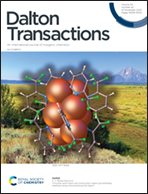
Electrocatalytic water oxidation by an unsymmetrical dicopper complex with bridging imidazole–aldoxime ligands in neutral phosphate buffer

Abstract
The electrocatalytic water oxidation activity of an unsymmetrical dicopper complex, 1, [Cu2(L1H)(L1)2(OH2)](ClO4)2, with a redox active imidazole–aldoxime ligand, L1H [L1H = N-hydroxo(4-methyl-imidazol-5-yl)methanimine], has been investigated. Complex 1 exhibits a turnover frequency of ∼302 s−1 in neutral phosphate buffer at about 473 mV overpotential with ∼94% faradaic efficiency. Electrochemical analysis suggests that the ligand moiety participates in a proton-coupled electron transfer (PCET) step during the catalytic cycle, enabling the complex to accumulate high oxidizing equivalents at the reaction center. Additionally, the asymmetric bridging mode of the oxime ligands promotes bimetallic cooperative catalysis in complex 1.

- This article is part of the themed collection: Celebrating International Women’s Day 2026: Women in Inorganic Chemistry
 Please wait while we load your content...


