Issue 12, 2025

Fluor-tools: an integrated platform for dye property prediction and structure optimization

Abstract

With the rapid advancement of fluorescent dye research, there is an urgent need for tools capable of accurately predicting dye optical properties while facilitating structural modification. However, the field currently lacks reliable and user-friendly tools for this purpose. To address this gap, we have developed Fluor-tools—an integrated platform for dye property prediction and structural optimization. The platform comprises two core modules: (1) Fluor-pred, a dye property prediction model that integrates domain-specific knowledge of fluorophores with a label distribution smoothing (LDS) reweighting strategy and an advanced residual lightweight attention (RLAT) architecture. This model achieves state-of-the-art performance in predicting four key photophysical properties of dyes. (2) Fluor-opt, a structural optimization module that employs a matched molecular pair analysis (MMPA) method enhanced with symmetry-aware and environment-adaptive modifications. This module derives 1579 structural transformation rules, enabling the directional optimization of non-NIR (non-near-infrared) dyes to NIR properties. In summary, Fluor-tools provides robust computational support for research in biomedical imaging and optical materials. The platform is freely accessible at https://lmmd.ecust.edu.cn/Fluor-tools/.
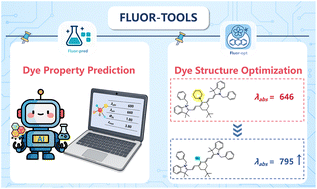
Graphical abstract: Fluor-tools: an integrated platform for dye property prediction and structure optimization

Supplementary files

Transparent peer review

To support increased transparency, we offer authors the option to publish the peer review history alongside their article.

View this article’s peer review history

Article information

Article type
Paper
Submitted
09 Sep 2025
Accepted
28 Oct 2025
First published
10 Nov 2025
This article is Open Access
Creative Commons BY-NC license

Digital Discovery, 2025,4, 3728-3743

Fluor-tools: an integrated platform for dye property prediction and structure optimization

W. Song, Y. Zhang, L. Xiong, X. Li, J. Zhang, G. Liu, W. Li, Y. Yang and Y. Tang, Digital Discovery, 2025, 4, 3728 DOI: 10.1039/D5DD00402K

This article is licensed under a Creative Commons Attribution-NonCommercial 3.0 Unported Licence. You can use material from this article in other publications, without requesting further permission from the RSC, provided that the correct acknowledgement is given and it is not used for commercial purposes.

To request permission to reproduce material from this article in a commercial publication, please go to the Copyright Clearance Center request page.

If you are an author contributing to an RSC publication, you do not need to request permission provided correct acknowledgement is given.

If you are the author of this article, you do not need to request permission to reproduce figures and diagrams provided correct acknowledgement is given. If you want to reproduce the whole article in a third-party commercial publication (excluding your thesis/dissertation for which permission is not required) please go to the Copyright Clearance Center request page.

Read more about how to correctly acknowledge RSC content.

Social activity

Spotlight

Advertisements