


 PLATFORM UPDATE:


Enhancing hydrogen adsorption on SnS2 and SnSe2 monolayers: alkali and alkaline earth metal decoration under external electric fields

Abstract
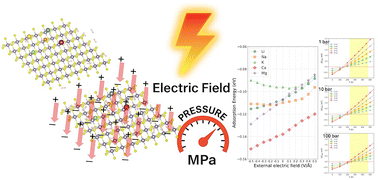
Efficient hydrogen storage is essential for advancing clean energy technologies. In this study, based on density functional theory (DFT), we report the hydrogen storage functionality of the post-transition metal dichalcogenides including SnS2 and SnSe2 monolayers modified by decoration with alkali (Li, Na, K) and alkaline-earth (Mg, Ca) metals. We reveal that Ca-decorated SnS2 and SnSe2 offer the most favorable hydrogen adsorption, with binding energies of approximately −0.15 eV per H2via strong physisorption. These systems can accordingly achieve the maximum gravimetric storage capacities ranging from 2.67 to 4.64 wt%. We further assess the key practical parameters relevant to storage capacities, including pressure, desorption temperature, and the influence of an external electric field. At a hydrogen pressure of 100 bar, the desorption temperatures for Ca–SnS2 and Ca–SnSe2 are calculated to be ∼226 K and ∼229 K, respectively. These values particularly approach the lower operational threshold of proton exchange membrane (PEM) fuel cells (∼233 K). Additionally, the desorption temperatures can be controllably modulated by 10–20 K through the application of a −0.5 V Å−1 electric field, a typical magnitude in gated device structures. This tunability arises from field-induced variations in surface polarity, which influence H2 binding energetics. Our findings highlight post-transition metal dichalcogenides as promising candidates for hydrogen storage, offering tunable performance through metal doping and external electric field control.
 Please wait while we load your content...


