


 PLATFORM UPDATE:


An ab initio study of high-voltage fluorine-rich cathodes for potassium ion batteries
 *a
and
Chuan-Fu
Sun
*a
*a
and
Chuan-Fu
Sun
*a
Abstract
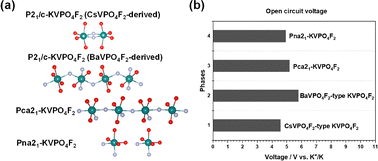
High-potential cathode materials are desirable for alkali metal ion batteries. Four fluorine-rich phosphate-based hosts including two monoclinic and two orthorhombic phases were explored through ion substitutions based on experimentally synthesized polyanionic compounds. These polymorphs were proved thermodynamically and dynamically stable by first-principles calculations. Although the KVPO4F2 family shares the same nominal chemical composition, the open circuit voltages (OCVs) varying from 4.57 to 5.78 V vs. K+/K have a strong dependence on the number of F− ions present in the VO6−xFx polyhedron; the more the F− ions bonded to the V atom, the higher the OCV that the V5+/V4+ redox pair in the framework could provide. Moreover, the layered phase crystalizing in the Pca21 space group exhibits an impressively low K+ ion migration barrier of 0.07 eV, which may endow the bulk material with fast-charging capability. Based on the Pca21-structured prototype, we tuned the cell potential by replacing F− ions with Cl− ions or substituting SO42− for PO43− anion groups. The resulting KVSO4F2 could deliver an average voltage of 4.71 V vs. K+/K and demonstrate a diffusion barrier of 0.12 eV, making it a promising high-energy and high-power cathode for practical applications. Our work may provide new insights into the discovery and design of high-voltage electrode materials for KIBs.
 Please wait while we load your content...


