


 PLATFORM UPDATE:


Multiconfigurational electronic structure calculations explain the role of ligands in g-tensor anisotropy for RuIII complexes
 *a
and
Yulia
Pushkar
*a
*a
and
Yulia
Pushkar
*a
Abstract
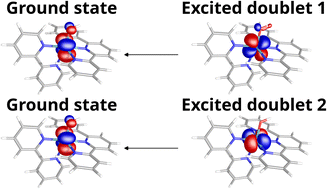
Identification of radical intermediates by means of electron paramagnetic resonance benefits from the theoretical computation of the EPR parameters such as g-tensor and hyperfine splitting. In this work, we provide a theoretical analysis for a dozen reactive RuIII intermediates catalyzing water oxidation, a key reaction in artificial photosynthesis. Using multireference methods, we compute g-tensor values and assess the errors against the experimental data. We provide a quantitative analysis of spin–orbit coupling through spinless triplet natural transition orbitals generalizing the El-Sayed–Kanamori rules. We show that the main factor determining g-tensor anisotropy is the energy difference between the nearly degenerate 4d-electronic states localized on the RuIII ion. Using natural orbitals, we explain the energy gaps between these states through a ligand-dependent partial charge transfer between Ru and ligands. We show that the energy gaps are strongly affected by the treatment of the weak electron correlation. Our calculations reproduce the previously reported experimental trends, which we now explain from a theoretical perspective. On the basis of our benchmark, we recommend a few modifications of the commonly used computational protocols.
 Please wait while we load your content...


