


 PLATFORM UPDATE:

Photoluminescence of crystals of the isomers d-(−)-arabinose and l-(+)-arabinose, and insights into its mechanism
 *abc
*abc
Abstract
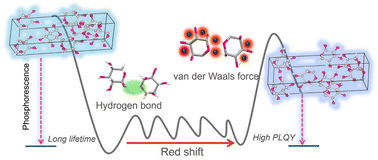
Nonconventional luminophores have attracted extensive attention due to their unique photoluminescence (PL) properties, including excitation-dependent emission and persistent room temperature phosphorescence, and intermolecular interactions play a key role in clustering-triggered emission (CTE). However, the diversity and complexity of atypical chromophores make it a significant challenge to accurately dissect the intrinsic structure of emissive clusters. In this work, the D-(−)-arabinose (D-Arb) and L-(+)-arabinose (L-Arb) stereoisomeric pair were selected as a model system to conduct comparative analysis of PL properties under controlled crystallization conditions. Experimental results show that D-Arb crystals exhibit redshifted emission, with a relatively high photoluminescence quantum yield reaching 9.26%, while L-Arb crystals have a longer phosphorescence lifetime of 199.5 ms. This study reveals that these differences in PL arise from the differentiated packing of D/L-Arb, which share a homologous molecular skeleton but exhibit distinct spatial configurations. Experimental and theoretical results revealed that D/L-Arb crystals form an abundant network of noncovalent interactions, including hydrogen bonds and short contacts between oxygen atoms. Analysis of key energy components intrinsic to the aggregates, such as the electrostatic, polarization, dispersion, and exchange repulsion components, indicates that these factors lead to varying degrees of electron delocalization in the emissive clusters. Combining these data with ab initio dynamics, the intrinsic relationship between the intermolecular interactions among D/L-Arb molecules and PL properties is more clearly revealed. These findings clarify the stereochemical control of emissive clusters via through-space interactions and establish a refined structure–property relationship for the design of optical isomers in CTE engineering.
 Please wait while we load your content...


