


 PLATFORM UPDATE:


Multifunctional ferroelectric synaptic memristors based on HfAlOx with enhanced Pavlovian learning and physical reservoir computing systems
Abstract
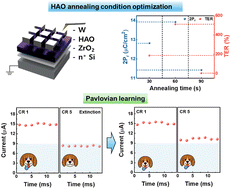
With the growing demand for energy-efficient, high-speed data processing systems, ferroelectric memristors based on HfAlOx (HAO) have emerged as promising candidates for neuromorphic computing. In this study, we fabricated a metal–ferroelectric–insulator–semiconductor structure with a W/HAO/ZrO2/n+ Si stack and investigated the influence of annealing duration at relatively low-temperature (500 °C) on ferroelectric and synaptic properties. Grazing incidence X-ray diffraction and positive-up-negative-down measurements revealed that a 60 second annealing process maximized the orthorhombic phase content and polarization characteristics. Electrical measurements showed enhanced tunneling electroresistance and memory window for a 60-second annealed device, while polarization reversal analysis confirmed the trade-off between the dead layer thickness and ferroelectricity. The 60-second annealed device also demonstrated superior read margin and synaptic behaviors, including potentiation/depression, spike based plasticity, and Pavlovian associative learning. Finally, a 4-bit reservoir computing system was successfully implemented, achieving 98.51% MNIST pattern recognition accuracy. These results highlight the potential of HAO-based ferroelectric memristors as low-power synaptic elements for future neuromorphic hardware.
 Please wait while we load your content...


