


 PLATFORM UPDATE:


Comparison of thermal conductivity modulation by uniaxial and biaxial strain in monolayer MoSe2: a first-principles calculation
 *a
*a
Abstract
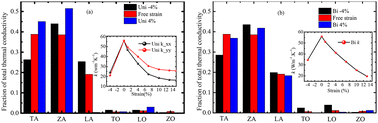
Strain engineering, including uniaxial and biaxial strain, has been an effective method to modulate the thermal properties of two-dimensional (2D) materials. However, the distinct effects of both strains on thermal conductivity remain poorly understood. First-principles calculations combined with the phonon Boltzmann transport equation are applied to analyze the phonon behaviors of monolayer MoSe2 under uniaxial and biaxial strains. It is found that the acoustic phonon branches still dominate thermal transport, despite the increased contribution of the optical branches to thermal conductivity under uniaxial strain. The maximum fraction of optical branches only accounts for 6.8% under 4% uniaxial compressive strain. In addition, the contribution of the TA mode (26%) to thermal conductivity is significantly suppressed, with those of both ZA (43.9%) and LA (25.4%) modes improved, under uniaxial compressive strain. However, contributions of both TA (45.4%) and ZA (51.5%) modes to thermal conductivity are increased, accompanied by a significant reduction in the contribution of the LA (0.37%) mode under uniaxial tensile strain. On the other hand, the effect of the TA (28.5%) mode on thermal conductivity is enhanced more, with the contribution of both ZA (43.5%) and LA (19.8%) modes slightly increasing under biaxial compressive strain. The differences in modulating thermal conductivity under both uniaxial and biaxial strains arise from distinct phonon mode responses governed by strain-induced lattice symmetry breaking. These findings provide insight for strain-engineered thermal transport regulation.
 Please wait while we load your content...


