


 PLATFORM UPDATE:

High-performance electronic and thermoelectric devices based on ferroelectric In2Se3/antimonene heterostructure

Abstract
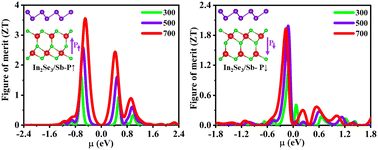
Inspired by the remarkable electronic properties of experimentally synthesized two-dimensional antimonene (Sb) and ferroelectric In2Se3 semiconductors, the electronic and thermoelectric properties of the ferroelectric In2Se3/Sb heterostructure are theoretically explored using first-principles calculations and Boltzmann transport theory. The results show that the electronic transport properties of the individual monolayers are improved in the In2Se3/Sb heterostructure, as evaluated with the HSE06 hybrid functional. The lattice thermal conductivity at room temperature is significantly lower for the heterostructure compared to the individual monolayers, owing to the strong coupling between optical and acoustic phonon modes, which leads to a reduction of group velocity in the In2Se3/Sb heterostructure. Remarkably, it exhibits low lattice thermal conductivity (up to 1.1 W K−1 m−1) and a high Seebeck coefficient (up to 2030 μV K−1). The estimated figure of merit for p-type doping in the heterostructure is around 3.6 at 700 K. Furthermore, the In2Se3/Sb heterostructure demonstrates impressive thermoelectric conversion efficiency (up to 22%) and thermionic refrigeration efficiency (up to 23.8% of the Carnot limit) at room temperature, emphasizing its potential for advanced cooling applications. The In2Se3/Sb heterostructure exhibits desirable heat capacity and an improved figure of merit, highlighting its potential as a strong candidate for effective thermoelectric devices.
 Please wait while we load your content...


