


 PLATFORM UPDATE:

Optically induced charge separation at the naphthalenediimide–phenothiazine interface
 a
Renan G.
de Assis,
b
Christine M.
Isborn,
c
Thiago B.
de Queiroz
b
and
Stephan
Kümmel
*a
a
Renan G.
de Assis,
b
Christine M.
Isborn,
c
Thiago B.
de Queiroz
b
and
Stephan
Kümmel
*a
Abstract
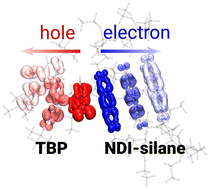
Naphthalenediimide (NDI) is stable under ambient air and an efficient electron acceptor due to its high electron affinity. Phenothiazine derivatives are paradigm electron donors due to their relatively low oxidation potentials and cations of high stability. Combining these two system classes therefore appears as a promising strategy for obtaining a material with attractive optoelectronic properties. We here investigate molecular models of π-coupled junctions of N,N′-bis[3-(triethoxysilyl)propyl]-1,4,5,8-naphthalenediimide (NDI-silane) and 3,7-di-t-butylphenothiazine (TBP) using time-dependent density functional theory. We calculate the electronic excitations for systems with frozen nuclei, and in a second step also investigate the influence that the dynamics of the nuclei has on the electronic excitations. We find optically active excitations around 1.5 eV that are associated with a charge transfer at the interface. We further calculate the electronic couplings between the states that are the most relevant ones for charge separation. Our findings can be seen as indicators for these materials' suitability for photovoltaic applications. First experimental results are in line with the theoretical conclusions.
 Please wait while we load your content...


