


 PLATFORM UPDATE:

Elucidating the impact of point defects on the structural, electronic, and mechanical behaviour of chromium nitride
 ab
and
Emilia
Olsson
*ab
ab
and
Emilia
Olsson
*ab
Abstract
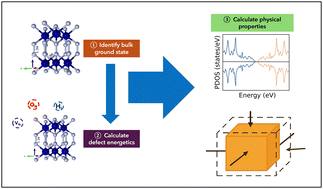
Defect engineering offers an important route to property tuning in hard coatings for advanced applications. Transition metal nitrides, such as CrN, are widely used for their mechanical resilience, but their nitrogen-rich analogue CrN2 remains poorly understood, especially at the atomic scale. This study employs density functional theory to investigate the energetics and how intrinsic defects (vacancies, interstitials, and anti-sites) and extrinsic impurities (hydrogen and oxygen) influence the structural, electronic, magnetic, and mechanical response of CrN2, in comparison to the more commonly studied CrN. With directional N–N bonding and semiconducting character, CrN2 shows high sensitivity to defect incorporation, including local spin polarisation, gap states, and mechanical softening. In contrast, CrN's metallic character enables effective screening of similar defects, preserving its structural, magnetic, electronic, and mechanical integrity. Hydrogen induces anisotropic distortions and mechanical degradation in CrN, while oxygen enhances hardness. These findings reveal how defect chemistry and bonding anisotropy govern mechanical performance, with implications for the design and optimisation of chromium nitride-based coatings.
 Please wait while we load your content...


