


 PLATFORM UPDATE:


Vibrational signature of 11B +u and hot 21A −g excited states of carotenoids revisited by femtosecond stimulated Raman spectroscopy

Abstract
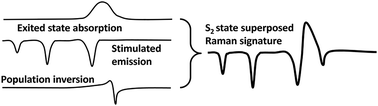
The significance of carotenoids in biological systems cannot be overstated. Their functionality largely arises from unique excited-state dynamics, where photon absorption promotes the molecule to the optically allowed 11B+u state (conventionally S2), which rapidly decays to the optically forbidden 21A−g state (S1). While the vibrational signature of the S1 state is well established, that of the initial S2 state has remained elusive. In this work, we identify a consistent S2-state vibrational signature across five different carotenoids and explain the challenges in isolating this signature. Resonance conditions in the near infrared region cause the S2 signal to appear as a complex superposition of contributions from stimulated emission to the ground state, excited-state absorption (S2 to Sm), and vibrationally inverted S1 signals. This results in a mix of positive and negative features that are not trivial to disentangle. After careful analysis, we isolated the genuine S2 signature, characterized by a C![[double bond, length as m-dash]](https://www.rsc.org/images/entities/char_e001.gif) C stretch near 1600 cm−1 and a C–C stretch near 1350 cm−1. The remaining signals originate from the ground or S1 states but are virtually inseparable from the FSRS signal on S2-state timescales. Our findings resolve a long-standing spectroscopic challenge and clarify the early excited-state dynamics of carotenoids.
C stretch near 1600 cm−1 and a C–C stretch near 1350 cm−1. The remaining signals originate from the ground or S1 states but are virtually inseparable from the FSRS signal on S2-state timescales. Our findings resolve a long-standing spectroscopic challenge and clarify the early excited-state dynamics of carotenoids.
 Please wait while we load your content...


