


 PLATFORM UPDATE:


Unveiling the role of the amino nitrogen–ruthenium cooperation effect in methanol steam reforming reaction via hydride transfer mechanism and Marcus theory

Abstract
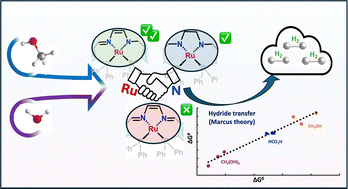
A DFT-guided methanol steam reforming reaction is performed to gain mechanistic insight into the reaction using Ru-PNNP pincer catalysts. Three Ru-pincer catalysts with respective structures of [Ru(Ph2PPh-{R1NR2N}–CH2–CH2N–CH2PhPPh2)H], where R1, R2 = (a) CH2–HCH2CH2, (b) CH![[double bond, length as m-dash]](https://www.rsc.org/images/entities/char_e001.gif) CH2CH2, and (c) CHCHCH, were selected with different nitrogen environments. We have explored the mechanistic details and the role of amino nitrogen centers in Ru-PNNP catalysts in methanol steam reforming reactions. We have correlated the reaction energy and kinetic barrier in different hydride transfer reactions using Marcus theory. The hydride transfer reaction in the methanol to formaldehyde formation pathway is the most energy-demanding. A direct water addition reaction with the metal aldehyde complex is energetically unfeasible and follows an alternative hydroxy methanolate path. The lone pair delocalization of participating nitrogen molecules disfavours the binding of the molecule and further hydrogen transfer reactions. A linear free energy relationship between the activation barrier and reaction energy is constructed for different hydride transfer steps. The reorganization energy for the hydride transfer reaction is linearly correlated with the binding energy of the participating molecules. The Marcus theory-based reorganization energy can be used as a valid descriptor for the design of catalysts when hydride transfer reactions directly control the rate-determining step and overall catalytic performance.
CH2CH2, and (c) CHCHCH, were selected with different nitrogen environments. We have explored the mechanistic details and the role of amino nitrogen centers in Ru-PNNP catalysts in methanol steam reforming reactions. We have correlated the reaction energy and kinetic barrier in different hydride transfer reactions using Marcus theory. The hydride transfer reaction in the methanol to formaldehyde formation pathway is the most energy-demanding. A direct water addition reaction with the metal aldehyde complex is energetically unfeasible and follows an alternative hydroxy methanolate path. The lone pair delocalization of participating nitrogen molecules disfavours the binding of the molecule and further hydrogen transfer reactions. A linear free energy relationship between the activation barrier and reaction energy is constructed for different hydride transfer steps. The reorganization energy for the hydride transfer reaction is linearly correlated with the binding energy of the participating molecules. The Marcus theory-based reorganization energy can be used as a valid descriptor for the design of catalysts when hydride transfer reactions directly control the rate-determining step and overall catalytic performance.
 Please wait while we load your content...


