


 PLATFORM UPDATE:


How to choose between molecular cooperation and non-cooperation for spontaneous self-organized patterning?
 *a
*a
Abstract
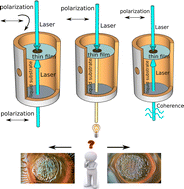
Spontaneous pattern formation in azopolymers is an example showing how a simple molecular process can give rise to complex, self-ordered structures. In this work, a novel experimental setup is introduced in which a thin azopolymer film floats on a liquid substrate, allowing molecules to move freely without the mechanical constraints imposed by rigid supports. This configuration with two lights illuminating the sample from above and below enables direct probing of the minimal informational and energetic conditions required for photoinduced molecular self-organization. Through a series of systematic experiments, laser polarization, intensity, and spatial coherence serve as key drivers of molecular cooperation. Each parameter exhibits a threshold: polarization dictates the orientation of surface gratings, intensity governs the collective molecular movement, and coherence synchronizes molecular phases. Entropy analysis provides a quantitative measure of disorder, showing how contradictory or insufficient optical inputs lead to loss of molecular cooperation and increased randomness in surface structures. Complementary simulations reproduce the observed thresholds and validate the governing equation of the system, bridging molecular-scale dynamics with emergent macroscale patterning. These insights advance the fundamental understanding of self-organization in photoactive materials and open pathways toward controlled surface engineering, with potential applications in photonics, microelectronics, and biointerfaces.
 Please wait while we load your content...


