


 PLATFORM UPDATE:


Thermal stability of l-cysteine-protected Au25 clusters: interplay between melting and ligand desorption
 b
Richard E.
Palmer
*a
and
b
Richard E.
Palmer
*a
and
Abstract
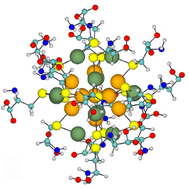
We investigate the thermal stability and melting of a monolayer-protected Au25Cys18 cluster using classical reactive molecular dynamics simulations. While the enhanced thermal stability of thiol ligand-protected gold clusters compared to corresponding unprotected gold clusters is well known, the mechanism of melting of the protected clusters has not yet been studied in detail. Our results demonstrate that the covalent bonding of the thiol ligands in a Au25Cys18 cluster stabilises the gold core against thermally induced isomerisation and melting. The Au25Cys18 cluster undergoes a melting phase transition at temperatures of ∼580–760 K, which exceeds by approximately 400 K the melting temperature of a bare Au25 cluster. The loss of thermal stability of the ligand-protected cluster occurs through an interplay of the metal core melting and the cascade evaporation of cysteine (Cys) ligands on the nanosecond timescale. The simulation results are validated by comparison with the results of ab initio calculations and relevant experimental data.
 Please wait while we load your content...


