


 PLATFORM UPDATE:


Effect of a peripheral substituent on the ultrafast dynamics and the rate of intersystem crossing in the charge-transfer states of platinum(ii) acetylides

Abstract
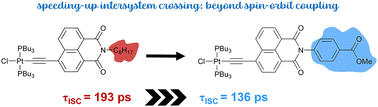
Ultrafast intersystem crossing into a triplet manifold of long-lived charge-transfer states following visible-light excitation is one of the many photophysical features of transition metal complexes that make them attractive for light-harvesting applications. Yet the spin–orbit coupling alone cannot explain the vast differences in the rates of ISC observed in similar transition metal complexes, ranging from sub-100 fs to tens or even hundreds of picoseconds. Here, we investigate how the rate of intersystem crossing and overall excited state dynamics of the two seemingly similar Pt(II) donor–acceptor molecules, Cl–Pt(PBu3)2–C![[triple bond, length as m-dash]](https://www.rsc.org/images/entities/char_e002.gif) C–NAP(X), where NAP = naphthalimide, are affected by peripheral changes to the acceptor. The dynamics of the systems was examined using ultrafast broadband fluorescence upconversion spectroscopy (FLUPs), femto-to-microsecond time-resolved infrared spectroscopy (TRIR), and electronic transient absorption spectroscopy (TA). Direct determination of the rate of ISC using FLUPs demonstrated that a change of the N-substituents “X” of the naphthalimide acceptor from an alkyl chain to the aromatic 4-(C(O)OMe)-Ph– group with an IR-active, electron-withdrawing substituent leads to a significant (30%) increase in the rate of intersystem crossing. The contributing factors to such an acceleration are proposed to be a decrease in the energy gap between the singlet charge-transfer state and the triplet manifold, and additional low-frequency vibrational modes associated with the phenyl-ester functional group which may act to promote intersystem crossing. Furthermore, expanding the range of the TRIR measurements into the microsecond timescale using synchronised picosecond excitation and a broad-band mid-IR femtosecond probe allowed us to directly obtain the signatures of long-lived excited states in the mid-IR region, thereby establishing that the final excited state populated in both cases is localised primarily on the acceptor ligand. Overall, this work highlights how the rates of excited state interconversion can be modulated by a seemingly benign peripheral modification.
C–NAP(X), where NAP = naphthalimide, are affected by peripheral changes to the acceptor. The dynamics of the systems was examined using ultrafast broadband fluorescence upconversion spectroscopy (FLUPs), femto-to-microsecond time-resolved infrared spectroscopy (TRIR), and electronic transient absorption spectroscopy (TA). Direct determination of the rate of ISC using FLUPs demonstrated that a change of the N-substituents “X” of the naphthalimide acceptor from an alkyl chain to the aromatic 4-(C(O)OMe)-Ph– group with an IR-active, electron-withdrawing substituent leads to a significant (30%) increase in the rate of intersystem crossing. The contributing factors to such an acceleration are proposed to be a decrease in the energy gap between the singlet charge-transfer state and the triplet manifold, and additional low-frequency vibrational modes associated with the phenyl-ester functional group which may act to promote intersystem crossing. Furthermore, expanding the range of the TRIR measurements into the microsecond timescale using synchronised picosecond excitation and a broad-band mid-IR femtosecond probe allowed us to directly obtain the signatures of long-lived excited states in the mid-IR region, thereby establishing that the final excited state populated in both cases is localised primarily on the acceptor ligand. Overall, this work highlights how the rates of excited state interconversion can be modulated by a seemingly benign peripheral modification.
- This article is part of the themed collection: 2025 PCCP HOT Articles
 Please wait while we load your content...


