


 PLATFORM UPDATE:

Specific and non-specific interactions of fibronectin with zwitterionic peptoid brushes studied by molecular dynamics simulation

Abstract
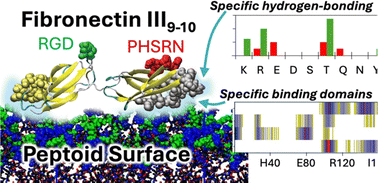
Zwitterionic polymer brushes represent a prominent class of surfaces to prevent non-specific protein interactions. However, residual protein binding and cell attachment can still be observed. Peptide-mimetic “peptoids” constitute a versatile sequence-specific platform for developing specific protein binding motifs as well as antifouling brushes. Nonetheless, molecular level insight into their protein interactions is generally lacking. Using atomistic molecular dynamics (MD) simulation, we analyse the interactions of fibronectin type-III (FnIII) 9- and 10-domains with a zwitterionic peptoid brush and compare it with polysarcosine, the well-known and uncharged elementary peptoid and potential PEG replacement. Experimental protein adsorption trends are used to determine the peptoid chain densities simulated. For each combination of peptoid and chain density, 9 independent simulations with different starting protein orientations are performed. The simulation results are consistent with experimental measurements over different chain densities, and they identified FnIII9-10 regions and specific amino acids with typical involvement in interactions with polysarcosine and the zwitterionic variant. Moreover, stronger interactions are seen for the zwitterionic peptoid design, and the protein's integrin binding motifs face away from the surface, nearly opposite in direction to the sequence segments interacting with the peptoids. These observations give new insight into protein–peptoid interactions and suggest the possibility of designing peptoid sequences for presenting cell-binding protein motifs and mediating cell attachment.
 Please wait while we load your content...


