


 PLATFORM UPDATE:


Assigning flavin's difference-FTIR spectral bands in solution: frequency and intensity shifts in flavin's 1-electron and 2-electron reduced states

Abstract
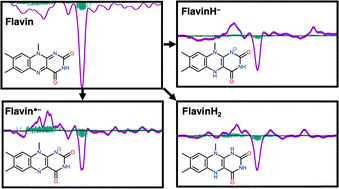
Flavins are versatile cofactors that undergo different redox, chemical, and/or photophysical transformations depending on the protein they are bound to. A powerful tool available for studying these transformations is Fourier transform infrared (FTIR) difference spectroscopy, where changes in the FTIR absorption bands relate to specific changes in flavin's bonding or interactions with its neighboring environment. While the infrared (IR) spectra of oxidized flavins are well-characterized, fewer computational and experimental studies have focused on characterizing the IR spectra of flavins in their reduced (radical semiquinone or hydroquinone) states. Here, we employ hybrid quantum mechanical/molecular mechanical (QM/MM) models with implicit solvation to compute vibrational frequencies and IR intensities for a model flavin (lumiflavin) in its oxidized, anionic semiquinone, anionic hydroquinone, and neutral hydroquinone states. The water solvent configurations around the flavin are sampled with molecular dynamics for each state. These simulations, applied with semi-empirically determined broadening and frequency-scaling factors, are used to assign the main features of experimental FTIR difference spectra in the diagnostic 1350–1750 cm−1 range from a variety of sources. The calculations show distinct, redox-state-dependent frequency shifts, especially for C![[double bond, length as m-dash]](https://www.rsc.org/images/entities/char_e001.gif) O stretching bands and CN stretching bands, consistent with changing formal bond orders in flavin's pteridine rings upon reduction. These shifts can serve as spectral fingerprints for specific radical and 2-electron reduced forms, which will aid in interpreting these bands in FTIR difference spectroscopy measurements of flavoproteins.
O stretching bands and CN stretching bands, consistent with changing formal bond orders in flavin's pteridine rings upon reduction. These shifts can serve as spectral fingerprints for specific radical and 2-electron reduced forms, which will aid in interpreting these bands in FTIR difference spectroscopy measurements of flavoproteins.
 Please wait while we load your content...


