Issue 42, 2025

Theoretical insights into the thermal conductivity of 2D hybrid perovskites based on a thermal resistance network model

Abstract

Understanding thermal transport in two-dimensional organic–inorganic hybrid perovskites (2D-HOIPs) is crucial for developing functional materials with ultralow thermal conductivity. In this work, we employ a thermal resistance network model to calculate the thermal conductivity of 2D-HOIPs and reveal an effective molecular design strategy for its reduction. Our findings demonstrate that replacing linear organic cations with branched ones significantly reduces thermal conductivity, making it up to four times lower than those of its linear counterparts, reaching as low as 0.07 W m−1 K−1. This study provides new insights into the tailoring of thermal transport in 2D-HOIPs through molecular engineering, offering a promising approach for thermal management and energy conversion applications.
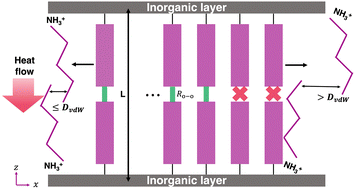
Graphical abstract: Theoretical insights into the thermal conductivity of 2D hybrid perovskites based on a thermal resistance network model

Supplementary files

Transparent peer review

To support increased transparency, we offer authors the option to publish the peer review history alongside their article.

View this article’s peer review history

Article information

Article type
Paper
Submitted
03 Jun 2025
Accepted
01 Oct 2025
First published
03 Oct 2025

Phys. Chem. Chem. Phys., 2025,27, 22473-22479

Theoretical insights into the thermal conductivity of 2D hybrid perovskites based on a thermal resistance network model

Q. Wang, X. Qian, T. Nakayama, J. Liu and J. Zhou, Phys. Chem. Chem. Phys., 2025, 27, 22473 DOI: 10.1039/D5CP02081F

To request permission to reproduce material from this article, please go to the Copyright Clearance Center request page.

If you are an author contributing to an RSC publication, you do not need to request permission provided correct acknowledgement is given.

If you are the author of this article, you do not need to request permission to reproduce figures and diagrams provided correct acknowledgement is given. If you want to reproduce the whole article in a third-party publication (excluding your thesis/dissertation for which permission is not required) please go to the Copyright Clearance Center request page.

Read more about how to correctly acknowledge RSC content.

Social activity

Spotlight

Advertisements