


 PLATFORM UPDATE:


Impact of nuclear number on SHG and THG performances: a comparative study of chiral mono- and dinuclear TbIII complexes with identical organic ligands

Abstract
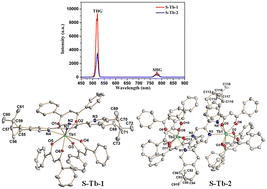
The reactions between Tb(dbm)3(H2O) and chiral bis-bidentate N-donor, (+)-2,5-bis(4′,5′-pinene-2′-pyridyl)pyrazine (S–L), in distinct molar ratios of 1 : 1 and 2 : 1, yielded two mono- and dinuclear chiral TbIII complexes, [Tb(dbm)3(L)]·2H2O (S-Tb-1) and [Tb2(dbm)6(L)]·4H2O (S-Tb-2) with identical organic ligands, where dbm− = dibenzoylmethanate. A study of their nonlinear optical effects indicates that S-Tb-1 and S-Tb-2 simultaneously show SHG and THG (second- and third-harmonic generation) effects with large intensity differences. The THG intensity of mononuclear S-Tb-1 is 2.7 times that of dinuclear S-Tb-2, and concurrently the SHG intensity of S-Tb-1 is 1.6 times that of S-Tb-2, mainly ascribed to the large difference in their molecular polarities. More notably, compared with the precursor Tb(dbm)3(H2O) only exhibiting a SHG response, the introduction of chiral S–L with a large π-conjugated system and symmetric molecular structure not only retains the SHG effect but also leads to the occurrence of a strong THG response in resultant S-Tb-1 and S-Tb-2. This interesting finding indicates that nuclearity can exert a pronounced influence on the SHG and THG performances of complexes containing identical organic ligands.
 Please wait while we load your content...


