


 PLATFORM UPDATE:


Novel multicomponent crystal forms of artesunate
 *b
and
Mingzhong
Li
*a
*b
and
Mingzhong
Li
*a
Abstract
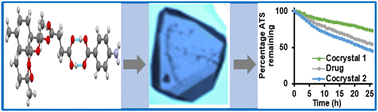
Artesunate (ATS), a BCS class II drug widely used for anti-malaria therapy, exhibits not only poor solubility but also poor stability. This study aimed to discover novel multicomponent crystal forms of ATS with improved physicochemical properties. Screening of 117 coformer candidates using mechanochemical solvent drop grinding (SDG) or solvent evaporation (SE) resulted in discovering five novel multicomponent crystal forms of ATS with 4-aminobenzoic acid (ABA), 1,4-diazabicyclo[2.2.2]octane (DABCO), 1,2-di(pyridine-4-yl)ethane (DPE), 1,10-phenanthroline (PHEN) and urea (URE). Based on the ΔpKa rule, FTIR results and structure analyses, these solids are cocrystals except DABCO. Additionally, ATS–URE cocrystals can be crystallised as different solvate forms, including methanol, ethanol, and acetonitrile. Interestingly two crystal forms of 2 : 1 ATS–DABCO have been discovered, i.e., form 1 is cocrystal and form 2 is salt. The crystal structures of these multicomponent ATS crystals were determined by single crystal X-ray diffraction and characterised by powder X-ray diffraction, Fourier transform infrared spectroscopy and different thermal analytical techniques (i.e., differential scanning calorimetry, thermogravimetric analysis and hot stage microscopy). It has been shown that some of the multicomponent ATS crystals can significantly improve the in vitro dissolution performance of ATS and its stability in solution. Unfortunately, the solid-state stability study shows that these multicomponent crystals do not exhibit better stability than the raw ATS under the conditions studied. In conclusion, the discovery of more multicomponent crystals of ATS with improved physiochemical properties (e.g., solubility and/or stability) could help to enhance its therapeutic efficacy.
 Please wait while we load your content...


