


 PLATFORM UPDATE:


Composition and transformation of sulfur-, nitrogen-, and oxygen-containing compounds in the hydrotreating process of a FCC slurry decant oil
 *ab
Quan
Shi
b
*ab
Quan
Shi
b
Abstract
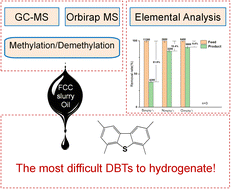
A FCC slurry decant oil was subjected to catalytic hydrotreating to investigate the molecular transformation of sulfur-, nitrogen-, and oxygen-containing compounds. A methylation/demethylation method was employed to isolate thiophenic species, enabling detailed characterization of heteroatomic compounds. The raw slurry oil and its hydrotreated product were characterized using gas chromatography-mass spectrometry (GC-MS), high-temperature simulated distillation, and Orbitrap mass spectrometry (Orbitrap MS). The process achieved 61.9% sulfur removal, with pronounced resistance observed in sterically hindered dibenzothiophenes, notably a C4-dibenzothiophene peak tentatively assigned as 2,4,6,8-tetramethyldibenzothiophene which showed no conversion. Nitrogen and oxygen compounds showed lower reactivities, with removal rates of 23.1% and 9.34% respectively, undergoing mainly ring saturation rather than complete heteroatom elimination. The study provides molecular-level insights into the hydrotreating behavior of heteroatomic compounds in slurry oils.
 Please wait while we load your content...


