


 PLATFORM UPDATE:


Determination of volatile acids in sugarcane spirits exploring an air drag system and digital image photometry

Abstract
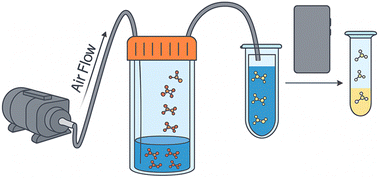
Quality control of sugarcane spirits is crucial to ensure optimal organoleptic properties and safety. High concentrations of volatile acids, including lactic, formic, and primarily acetic acid, indicate microbiological contamination in the fermentation step and directly affect the taste and flavor of sugarcane spirits, reducing their economic value. The official method relies on acid–base titration after a distillation step to discriminate volatile and non-volatile acids, which is cost-effective, but time-consuming, laborious, and generates high waste volumes. Gas chromatography with a flame ionization detector (GC-FID) is an alternative, but it is laborious and may be expensive for low- to moderate-scale producers. This work proposes a novel analytical procedure for determining volatile acids in sugarcane spirits, based on an air drag system and photometric measurements using a smartphone camera. Digital videos were explored to optimize the working conditions, aiming to maximize the extraction of volatile acids. Under the optimized conditions, a linear response was achieved from 6 to 150 mg L−1 (r2 > 0.99), with a limit of detection of 2 mg L−1 and a coefficient of variation of 5.4% (n = 8). Recovery values ranged from 95 to 114%, demonstrating the absence of matrix effects. Accuracy was assessed by comparison to the GC-FID method, with agreement at the 95% confidence level. The proposed method is a sustainable, green, and cost-effective alternative, with AGREE and NQS scores of 0.71 and 61%, respectively.
 Please wait while we load your content...


