


 PLATFORM UPDATE:


Rapid, clean and quantitative analysis of Cu2+ in copper refining electrolyte via chemometrics-driven Vis–SWNIR absorption spectroscopy
 †a
Linhua
Jiang,
*a
†a
Linhua
Jiang,
*a
Abstract
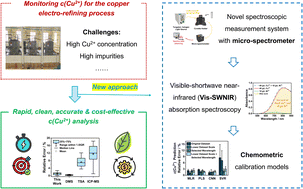
The development of rapid and non-destructive monitoring methods for Cu2+ concentration in copper refining electrolyte is of great significance for improving product quality and pollution control in the copper smelting industry. However, the spectral behavior of high-concentration Cu2+ in electrolytes and the presence of multiple impurities pose major hindrances to the development of such technologies. Herein, a novel spectroscopic measurement system is proposed: by integrating visible–shortwave near-infrared (Vis-SWNIR) absorption spectroscopy with chemometric calibration models, it can achieve clean, rapid, accurate, and cost-effective quantification of high-concentration Cu2+. Combined UV-Vis-SWNIR spectroscopy and chemometric analyses revealed that among electrolyte impurities, only Ni2+ affects the Vis-SWNIR region spectral analysis of Cu2+, with both high-concentration Cu2+ and Ni2+ exhibiting strong linear concentration–absorbance relationships. A spectral dataset (n = 600) was established using the system, incorporating Cu2+ and screened impurities at concentrations simulating real electrolytes. Four calibration models (CNN, MLR, PLS, and SVR) were trained, with the optimized model achieving a relative error of 1.1% for simulated samples. A comparative analysis revealed that the developed system (with an instrument cost of only ∼700 $ USD) not only outperforms conventional Cu2+ monitoring methods in accuracy, but also offers advantages of rapid monitoring, low analytical cost, and pollution-free operation. The proposed spectroscopic measurement system not only has potential applications in cleaner and more efficient copper refining processes, but also provides a promising solution for real-time, non-destructive monitoring of high-concentration, impurity-rich complex liquids.
 Please wait while we load your content...


