


 PLATFORM UPDATE:


On-chip integration of electromembrane extraction and thin-film solid-phase microextraction using polyaniline/graphene oxide composite for determination of synthetic dyes in beverage and environmental samples

Abstract
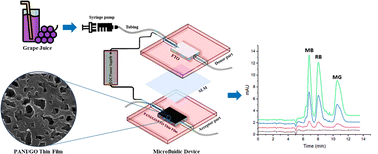
In this study, an integration of on-chip electromembrane extraction (EME) and thin-film solid-phase microextraction (TF-SPME) was developed for the determination of cationic synthetic dyes, including methylene blue, malachite green, and rhodamine B in beverage and environmental samples. The device consisted of two separate chambers: one for the sample solution (donor phase) and one for acceptor phase. A conductive thin-film of polyaniline/graphene oxide (PANI/GO) nanocomposites was deposited electrochemically on a fluorine-doped tin oxide surface, which served as the TF-SPME sorbent and electrode in the acceptor chamber. During extraction, target analytes migrated under an electric field and were simultaneously adsorbed onto the PANI/GO coating. A desorption solvent was subsequently introduced into the acceptor phase to elute the analytes, which was analyzed by high-performance liquid chromatography with ultraviolet detection (HPLC-UV). Optimization of the key parameters affecting the extraction was carried out to maximize the efficiency. Under optimal conditions, limits of detection in the range of 1.5–3 μg L−1 were achieved. The method exhibited linearity within 10–1000 μg L−1 for malachite green and 5–1000 μg L−1 for methylene blue and rhodamine B (R2 ≥ 0.9963). The applicability of the proposed technique was evaluated by determining the model analytes in grape juice, fish farming river water, and textile industry wastewater, yielding relative recoveries ranging from 96.5% to 116.8%. Consequently, the integration of EME/TF-SPME and the use of PANI/GO in the acceptor phase were found to be successful in determination of cationic dyes in environmental samples.
 Please wait while we load your content...


