


 PLATFORM UPDATE:

Carvedilol microemulsion-loaded oleogel: development and validation via an HPLC method, identification of three degradation products, and toxicity prediction
 b
Kamal
Sweidan
*a
b
Kamal
Sweidan
*a
Abstract
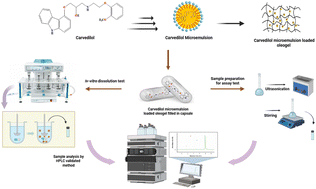
In this work, carvedilol (CARV) was formulated as a microemulsion-loaded oleogel (CARV-MEOG) to enhance its solubility. An HPLC analytical method was developed and validated for assay, content uniformity, and dissolution tests. The mobile phase was composed of a 55 : 45 (v/v) mixture of 0.015 M phosphate buffer, adjusted to pH 2.7 ± 0.05, and acetonitrile, with its flow rate set at 1.2 mL min−1. The separation was conducted using Luna C18 (250 × 4.6) mm, 5 μm column at 35 °C and a wavelength of 240 nm. The injection volumes were 10 μL for the assay and content uniformity study and 100 μL for the dissolution studies. Validation was carried out in accordance with the ICH Q2(R1) guidelines. The method proved to be precise, rugged, accurate, selective, specific, and linear in the concentration range of 13.0–30.0 μg mL−1 for assay and content uniformity and 0.21–34.0 μg mL−1 for dissolution studies. In the assay, the forced degradation of CARV, CARV-MEOG, and excipients under stress conditions revealed three major degradants with well-resolved peaks, with RRT of 1.4, 3.7, and 4.2, respectively. The molecular masses of the observed degradants were determined using LC/MS, and their chemical structures were proposed. ADMET analysis showed that degradant 1 exhibits altered permeability and genotoxicity (AMES toxic), while degradants 2 and 3 retain similar pharmacokinetics to CARV.
 Please wait while we load your content...


