


 PLATFORM UPDATE:


Application of excitation-emission fluorescence spectroscopy and 2DCNN for quantitative analysis of diesel emulsified oil content
 *b
*b
Abstract
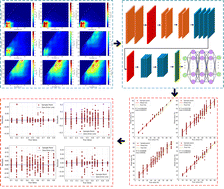
Accurate quantitative analysis of emulsified oil content is regarded as a critical technique for assessing pollution levels and environmental risks associated with marine oil spills. In this study, a quantitative analysis method based on a two-dimensional convolutional neural network (2DCNN), partial least squares regression (PLSR) and excitation-emission fluorescence spectroscopy (EEFS) was proposed for the quantitative analysis of diesel emulsified oil content. First, the EEFS data of diesel emulsified oils with different oil contents were collected using an FLS1000 spectrometer, and their spectral and spatial structures were analyzed. Second, a 2DCNN incorporating an attention mechanism and regularization technique (AR-2DCNN) was developed to extract the EEFS features of diesel emulsified oils. Finally, the extracted EEFS features were quantitatively analyzed using PLSR based on contribution rate (CR-PLSR). Results demonstrated that the proposed AR-2DCNN + CR-PLSR method outperformed the traditional methods including ResNet-50 and ConvNeXt combined with CR-PLSR. These findings validated the effectiveness of the proposed method in emulsified oil content measurement and highlighted its potential application in marine oil spill detection.
 Please wait while we load your content...


