


 PLATFORM UPDATE:


An automated illumination system for high-throughput photopharmacology studies: a case study of ROS-sensitive Zn- and Pd-phthalocyanine-loaded liposomes

Abstract
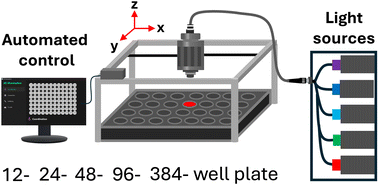
High-throughput approaches for studying light-activated compounds are in high demand in biomedical applications. In this work, we designed and validated a cost-effective illumination platform that is easy to fabricate, customizable, and suitable for high-throughput in vitro studies. We demonstrated the performance of our system using a comparative study of reactive oxygen species (ROS)-sensitive liposomes loaded with two structurally identical phthalocyanines differing in their central metal, namely zinc and palladium. We showed that our system allows screening of a large set of chemical parameters in a short period of time for the optimization of light-triggered drug delivery systems, such as dye loading, power density, light dosage, and aerobic/anaerobic environment. Upon optimization, Pd(II) phthalocyanine-loaded liposomes released up to 100% of calcein, while Zn(II) phthalocyanine-loaded liposomes achieved only 50% release under the same conditions, i.e., 690 nm incident light and 10 J cm−2 light dosage. Under anaerobic conditions, the calcein release was markedly reduced for both liposomes, confirming its ROS-dependent nature. The illumination system performed reliably throughout the study.
 Please wait while we load your content...


