


 PLATFORM UPDATE:

Ratiometric detection of human serum albumin using an aggregation-induced enhanced emission-conjugated polyelectrolyte and a prototype smartphone device
 a
Laxmi Raman
Adil,
a
Priyam
Ghosh
a
and
Parameswar Krishnan
Iyer
*abc
a
Laxmi Raman
Adil,
a
Priyam
Ghosh
a
and
Parameswar Krishnan
Iyer
*abc
Abstract
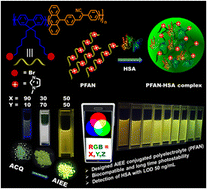
Controlling the molecular motion and charge transfer in any luminogenic material is the key to optimizing its photo-physical properties for desired applications. Fluorescent conjugated polyelectrolytes (CPEs) possess both complexity and huge diversity, and their structure-motion-property relationship remains immensely intriguing. The incorporation of an AIEE (aggregation-induced enhanced emission) monomer with a twisted donor–acceptor (D–A) architecture is a specific strategy to tune the photo-physical and sensing properties of a CPE. Conjugated polymers P1, P2 and P3 were strategically designed by changing the mole percentage of the AIEE unit in the polyfluorene backbone, which resulted in a significant shift in the emission from blue (P1) to white (P2) and yellow (P3). Moreover, their condensed state emission property was improved, thereby converting an ACQ polymer (P1) into a polymer (P3) and into an AIEE polymer. Finally, a PFAN polyelectrolyte was derived from the AIEE-P3 polymer for monitoring the levels of human serum albumin (HSA) in real serum samples. Furthermore, the PFAN CPE-based HSA detection technology was miniaturized into a prototype smartphone device to enhance patient care, particularly for the elderly or patients with chronic illnesses.
 Please wait while we load your content...


