Issue 22, 2025

Detection of carbapenemase-mediated antimicrobial resistance using surface-enhanced Raman scattering

Abstract

Antimicrobial resistance (AMR) poses a significant global health threat, necessitating rapid and precise detection methods. One widespread mechanism of AMR involves bacterial production of β-lactamase enzymes which render β-lactam antibiotics ineffective. The ability of β-lactamases with carbapenemase activity to degrade carbapenems, β-lactams used as antibiotics of last resort, is of particular concern. Carbapenemase-producing organisms (CPOs) cause infections with high mortality rates, hence, their timely detection is of utmost importance. Here, we applied surface-enhanced Raman scattering (SERS) to the detection of carbapenemase activity, where our data reveal that enzyme-catalyzed carbapenem hydrolysis results in distinct spectral fingerprint changes. We capitalize on this finding by illustrating an experimental methodology implementing SERS that permits the detection of CPOs.
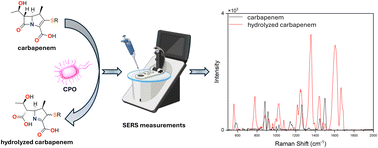
Graphical abstract: Detection of carbapenemase-mediated antimicrobial resistance using surface-enhanced Raman scattering

Supplementary files

Transparent peer review

To support increased transparency, we offer authors the option to publish the peer review history alongside their article.

View this article’s peer review history

Article information

Article type
Communication
Submitted
06 Aug 2025
Accepted
29 Sep 2025
First published
02 Oct 2025
This article is Open Access
Creative Commons BY-NC license

Analyst, 2025,150, 4925-4929

Detection of carbapenemase-mediated antimicrobial resistance using surface-enhanced Raman scattering

Z. Wang, H. Bhattacharjee, M. A. Jeffs, R. A. V. Gray, Y. Bdour, A. Docoslis, C. T. Lohans and C. Escobedo, Analyst, 2025, 150, 4925 DOI: 10.1039/D5AN00839E

This article is licensed under a Creative Commons Attribution-NonCommercial 3.0 Unported Licence. You can use material from this article in other publications, without requesting further permission from the RSC, provided that the correct acknowledgement is given and it is not used for commercial purposes.

To request permission to reproduce material from this article in a commercial publication, please go to the Copyright Clearance Center request page.

If you are an author contributing to an RSC publication, you do not need to request permission provided correct acknowledgement is given.

If you are the author of this article, you do not need to request permission to reproduce figures and diagrams provided correct acknowledgement is given. If you want to reproduce the whole article in a third-party commercial publication (excluding your thesis/dissertation for which permission is not required) please go to the Copyright Clearance Center request page.

Read more about how to correctly acknowledge RSC content.

Social activity

Spotlight

Advertisements