


 PLATFORM UPDATE:

A redox-reversible A/B-site co-doped BaFeO3 electrode for direct hydrocarbon solid oxide fuel cells†

Abstract
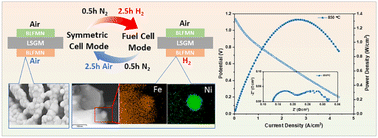
Solid oxide fuel cells (SOFCs) can directly convert the chemical energy in fuel to electrical energy with fuel flexibility; however, the conventional nickel-based anodes face great challenges due to coking upon direct oxidation of hydrocarbon fuels and redox instability. Thus, developing new anode materials which can provide high coking resistance as well as redox stability is crucial. In this work, Ba0.6La0.4Fe0.8Mo0.1Ni0.1O3−δ (BLFMN) has been synthesized in air using a sol–gel combustion method, resulting in a dual phase consisting of a cubic BLFMN main phase and scheelite BaMoO4 (BMO4) secondary phase. By heat-treating the BLFMN dual phase in H2 at 800 °C for 5 h, a metallic nanoparticle-decorated BLFMN triple phase compound comprising cubic BLFMN, cubic BaMoO3 (BMO3) and in situ exsolved FeNi3 alloy was obtained. BLFMN was subsequently investigated as an electrode material for La0.8Sr0.2Ga0.83Mg0.17O3−δ (LSGM) electrolyte (300 μm) supported SOFCs. Symmetrical cells using BLFMN as electrodes with the cell configuration of BLFMN//LSGM//BLFMN showed excellent redox reversibility and a peak power density (PPD) of 1.32 W cm−2 at 850 °C when using H2 as fuel. Single cell with the cell configuration of BLFMN//LSGM//LSCF (La0.6Sr0.4Co0.2Fe0.8O3−δ) reached PPD of 1.61 and 0.41 W cm−2 at 850 °C when operating with H2 and CH4 fuel, respectively. Moreover, the single cell exhibit excellent stability (over 300 h) upon direct oxidation of hydrocarbon fuels of CH4 and C3H8. This study indicates that BLFMN is a promising redox reversible and coking resistant anode for SOFCs.
 Please wait while we load your content...


