


 PLATFORM UPDATE:


Excellent phosphorus-doped porous carbon oxygen reduction reaction catalysts derived from natural wild Angelica dahurica
 a
a
Abstract
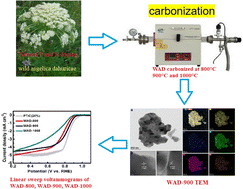
At present, phosphorus-doped porous carbon–oxygen reduction catalysts prepared by chemical methods are not able to achieve good performance. In order to improve the catalytic performance of the phosphorus-doped oxygen reduction reaction (ORR), wild Angelica dahurica (WAD) with abundant phosphorus was used as a carbon carrier and phosphorus source at the same time. Phosphorus-doped carbon-based materials based on carbonization of biomaterials also had a homogeneous structure and excellent stability. WAD directly carbonized at 900 °C (WAD-900) had a half-wave potential of 0.822 V relative to a reversible hydrogen electrode, a limiting current density of 4.54 mA cm−2 at 1600 rpm, an average number of transferred electrons of four, and a stability of 95.9% for 20 000 s, larger than the 82.6% of Pt/C. This study demonstrates the excellent performance of naturally occurring phosphorus dopants in oxygen reduction reactions and their favorable catalysis properties, opening up a new direction for chemical dopants that find it difficult to achieve good performance.
 Please wait while we load your content...


