


 PLATFORM UPDATE:

Design strategy of encapsulated nanoplates and nanorods (ID-CoMo): enhanced catalytic activity and sustainability for overall & solar cell water splitting†

Abstract
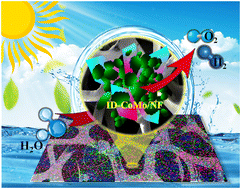
Effective bifunctional ID-CoMo electrocatalysts must be strategically constructed to advance the technology for the conversion and storage of renewable energy. Herein, we report a simple and effective insertion dehydration (ID) method to synthesize encapsulated cobalt–molybdenum oxide (ID-CoMo). The electrical characteristics, geometric morphologies, and chemical composition of ID-CoMo were specifically altered by encapsulation to produce more active sites with potential characteristics and high catalytic activity. In encapsulation, metal–metal interaction induced bi-functionality which leads to a synergistic effect through an improvement of catalyst activity. Among the synthesized catalysts (ID-CoMo, CoO and MoO), ID-CoMo exhibits superior OER and HER activity, delivering small overpotentials of 270 mV (OER) and 125 mV (HER) at 10 mA cm−2 with low Tafel slopes of 68.3 mV dec−1 (OER) and 72.7 mV dec−1 (HER) and is stable for ∼150 h with minimum potential loss. Furthermore, the enhanced OER and HER activity of ID-CoMo can be attributed to the encapsulated structure which leads to high electrochemical surface area and synergistic effects of Co and Mo metal atoms.
 Please wait while we load your content...


